
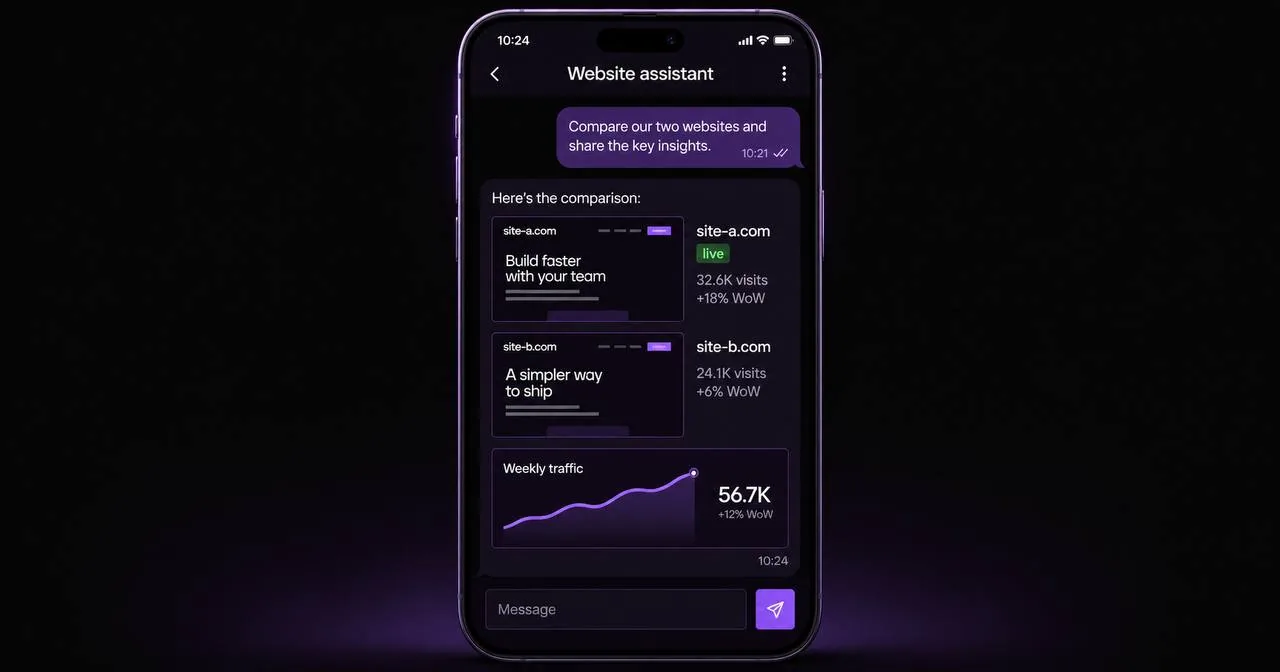
In September 2026 a startup called Photon held a funeral for mobile apps, complete with speeches. TechCrunch, reporting on Photon's $4.5 million seed round in October, called the event "obviously somewhat tongue-in-cheek" — and it was. Photon builds infrastructure that lets AI agents live inside iMessage, WhatsApp, Telegram, Slack and other messengers, so a dramatic send-off for apps was good theatre.
The interesting part is what came after the joke. Asked about the shift, Photon's CEO Daniel Tian did not claim apps are already dead. "Honestly, it's going to take a while," he told TechCrunch, "but I think, directionally, it's inevitable."
That is the honest version of the story, and it is the one worth paying attention to. Nobody needs to delete their apps or their admin panels this year. But the direction is clear: people increasingly expect to get things done in the chat they already have open, instead of logging into yet another tool.
What small businesses actually want
When we talk to owners of small businesses and to agencies managing several client projects, the request is rarely "build us an AI". It sounds more like this:
- "I just want to know how the new landing page did yesterday."
- "Can someone change the headline before the campaign goes out?"
- "Where did that form submission go?"
- "Who changed the pricing block last week?"
Each of these questions has an answer somewhere: in analytics, in server logs, in a CMS, in a repository, in someone's inbox. The problem is that the answer lives in five different places, each with its own login, and the person asking is usually on their phone between two meetings.
What they want is simple to describe: access to their whole system from one chat. Ask a question and get an answer. Look at the numbers. Request a change and see it go live — safely.
A real setup: running websites from Telegram
We run exactly this kind of setup for a group of company websites. The details are worth sharing, because they show what "the app moves into the messenger" means in day-to-day work, without the hype.
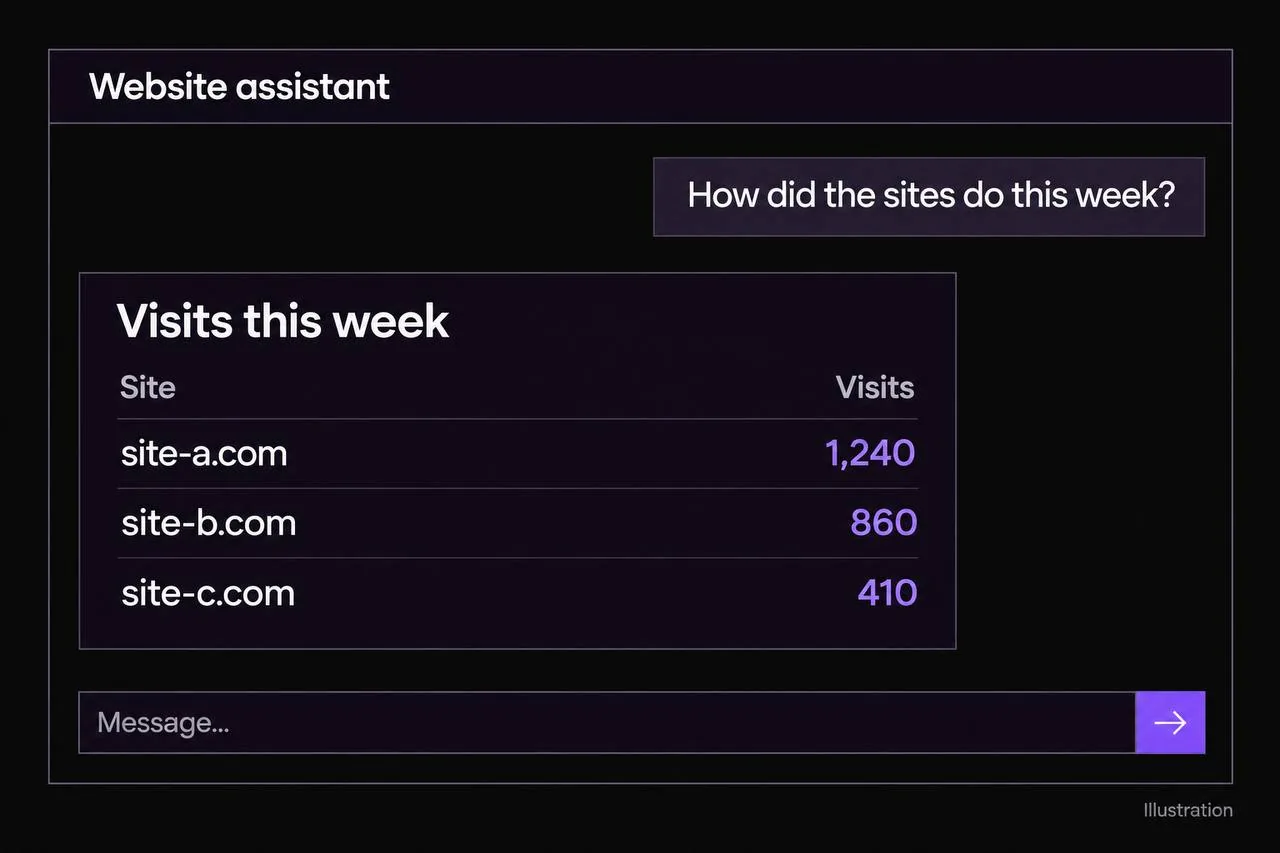
Statistics on request. A manager writes to the assistant in Telegram: "How did the sites do this week?" The assistant reads the web server logs directly and replies with visits, top pages and traffic sources for each site. No dashboard to open, no export to download. If a deeper look is needed, a small mini-app inside Telegram shows the same data as charts.
Changes in plain language. The manager writes: "On the main landing page, change the hero headline to this text and update the contact email." The assistant prepares the edit and shows it as a card in the chat: what will change, on which site, and a preview. Nothing goes live until a person with the right permissions presses "Approve".

Rollback in one message. If something looks wrong after publishing, "Roll back the last change on that site" produces another card — and, after approval, the previous version is back. Every edit is recorded, so "who changed the pricing block last week?" has a straight answer.
Questions about anything connected. The same chat can answer "Did anyone submit the contact form today?" or "What's on our task board for Friday?", because form relays and task boards are connected to the same assistant.
The manager never logs into a hosting panel. The developers still own the code, the servers and the review process. The chat simply becomes the front door.
Why this works for agencies in particular
Agencies live with a specific kind of chaos: many clients, many sites, many small requests, and a client who would like it done "today, if possible". A chat-based assistant changes the economics of the small request.
- Fewer context switches. A headline change does not need a ticket, a developer's attention and a deployment window. It needs a clear request, a preview and an approval.
- Clients get answers without access to everything. A client can ask about their own site's numbers in a shared chat, without being given a login to your hosting or analytics account.
- A record by default. The chat history plus the edit log becomes the audit trail you never had time to keep.
What makes it safe
"Let an AI edit my website" sounds risky, and it should, if done carelessly. The difference between a gimmick and a tool you can trust comes down to a few design decisions:
- Read freely, write with approval. Answering questions and reading statistics can be instant. Anything that changes a live system goes through a confirmation step by a named person.
- Narrow permissions. The assistant gets access only to what it needs: specific sites, specific folders, specific actions. It never sees passwords or keys in the conversation.
- Everything reversible. Every change is versioned and can be rolled back from the same chat.
- A log you can read. Who asked, what was changed, who approved and when.
None of this requires replacing your existing tools. The assistant sits on top of what you already run: your hosting, your analytics, your forms, your task board.
Which messenger?
Telegram is the easiest place to start: its bot platform is open, supports buttons and mini-apps, and works well for internal teams. Slack fits teams that already live there. WhatsApp is where many customers are, but it has stricter platform rules for AI assistants, so it suits customer-facing assistants for a specific business rather than general-purpose bots. Photon's bet is that one agent will eventually be reachable through all of them. For a small business today, the practical advice is to start where your team already talks.
How to start without a big project
You do not need an "AI strategy" for this. You need one annoying, repeated task:
- pick the question you or your clients ask most often ("how did the site do?", "did anyone write to us?");
- pick one safe change you make often (texts, prices, contact details);
- connect those two things to a chat, with approval on every change;
- use it for a few weeks, then decide what to connect next.
Apps are not going to a real funeral any time soon. But the habit is shifting: people want the answer, the number and the change in the place where they already are. For small teams and agencies, that is less a revolution than a relief.
Let's talk
Want to manage your sites, statistics and edits from a chat? Tell us what you check and change most often, and we'll suggest a first step. Discuss your project: cybergizer.com/contact or sales@cybergizer.eu.
Source: Sarah Perez, "Photon held a funeral for mobile apps. Now it has $4.5M to help replace them with agents", TechCrunch, 1 October 2026.